
Why Is Water Pressure Low in Your Stuart, FL Home?
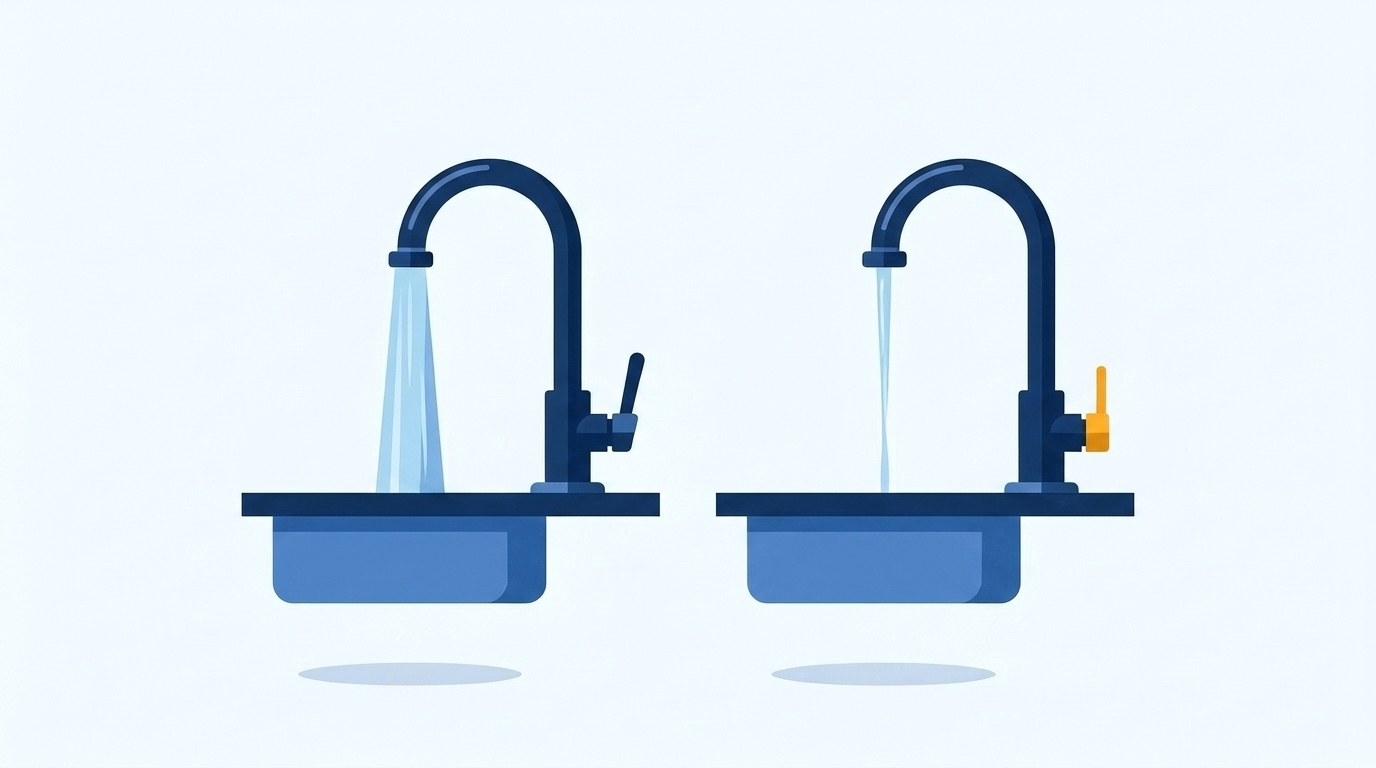
Low water pressure across a whole Stuart house has a short list of causes: a supply problem on the utility's side of the meter, a valve or regulator that is holding water back, a leak, or supply lines narrowed by age. The timeline sorts them. Pressure that fell within days points at the first three. Pressure that faded over years points at a fouled regulator or at the pipes themselves.
Age matters in Stuart. The U.S. Census Bureau's 2020 to 2024 American Community Survey five-year estimates put the median year built for housing units in the city of Stuart at 1982, against 2002 for Port St. Lucie.
Is Your Stuart Home Losing Water Pressure Suddenly or Slowly?
One fork comes first. If a single faucet or shower is weak and the rest are strong, the trouble is at that fixture: an aerator, a showerhead or a cartridge. The rest of this post is about the other case, where every tap is weak.
Pipe does not corrode overnight, so a drop that arrived within a day or a week points to an event: a main shut-off or meter valve not fully reopened after a repair, a regulator that has fouled or failed, a break or maintenance on the utility's lines, or a new leak. The water-meter test in our guide to the signs of a hidden water leak is the check for that last one.
Pressure that faded over months or years has a different list. Nothing broke. Something wore: a regulator collecting debris, or the inside of the supply lines.
When Is Low Water Pressure a Utility Problem in Stuart?
It is a utility problem when the cause is in the utility's own system, upstream of your meter. The signs are a sudden drop at every tap, the hose bib included, and neighbors who have it too. Martin County's Report Low or No Water Pressure page lists line breaks, maintenance and a plumbing leak among the possible causes, and takes reports through a request form.
Which utility gets the report depends on the address. The City of Stuart's Utility Division describes a service area covering a majority of the properties inside the city plus a small area of unincorporated Martin County, and Martin County Utilities says it serves unincorporated areas of the county. The name on the water bill settles it.
For homes billed by Martin County Utilities, the county's Water Service Line Inventory page puts the line at the meter: the county is responsible for the service line from the main to the meter, and the property owner from the meter into the home.
One number needs care. Martin County Utilities' Minimum Design and Construction Standards (revised August 2016) and the City of Stuart's Water and Sewer Standard Specifications (October 2021) each have water mains sized to hold a residual 20 psi under maximum-day demand plus fire flow, or under peak-hour demand, whichever is greater. That is a design floor for the mains at their heaviest load, not a promise about your kitchen tap.
A home on a private well makes its own pressure with a pump and a pressure tank, which our post on how long a well pump lasts in Palm City covers. And where the utility's supply is simply too low for a home's fixtures, the remedy is a pressure booster system, not a repair inside the house.
Is a Failing Regulator Behind Low Water Pressure in Stuart Homes?
Only in a house that has one. A pressure regulator, or pressure-reducing valve, sits on the supply line into the house and holds the pressure inside below what the main delivers. The Florida Building Code, Residential, 8th Edition (2023), section P2903.3.1, caps static water pressure at 80 psi and requires a pressure-reducing valve where the main pressure exceeds that. So a Stuart home may not have one at all.
Zurn Wilkins's instruction sheet for its Model NR3XL regulator shows the valve installed after the water meter and shut-off valve, and says it is factory set to approximately 50 psi. Its troubleshooting entry for unsteady or inadequate fixture pressure names two causes at the valve itself: a setting that is too low and a screen clogged with debris.
Can you turn it up yourself? Zurn's sheet says an owner who is not qualified to inspect and maintain the valve must bring in a qualified plumber. It sets conditions on any adjustment: a pressure gauge downstream to verify the setting, an adjustment bolt that is not bottomed out, and an increase made gradually. The steps are in the sheet, and the code's cap on static pressure applies to the new setting.
How Do You Test Water Pressure at the Hose Bib With a Gauge?
A hose bib pressure gauge threads onto an outdoor faucet like a garden hose and reads in psi. It is one of the tools on the instruction sheet for Zurn's Model NR3XL regulator, and this is that sheet's test, in its order. Its condition comes first: an owner who is not qualified to inspect and maintain the valve must bring in a qualified plumber.
- If it is available, determine the incoming supply pressure for reference.
- Install the gauge on a hose bib on the house side of the regulator, as the sheet's diagram shows.
- Open a fixture inside the house so water flows through the regulator.
- Record the gauge reading. This is the reduced flowing pressure.
- Close the inside fixture and immediately record the reading again. This is the reduced static pressure, the valve's outlet set point.
- Watch the gauge for 10 minutes.
Zurn's criteria follow. Pressure that holds for the 10 minutes without increasing means the valve is working properly. Pressure that increases immediately to the supply pressure from step 1 means the valve may be severely fouled, damaged or defective and should be repaired or replaced. Pressure that creeps up slowly within the 10 minutes means it may be fouled and should be cleaned and retested, then repaired if it still creeps. Leakage from the body means replacement, and from the bell, repair. The sheet holds the cleaning and repair steps, warns about trapped pressure, and says a qualified plumber should install the valve.
Those criteria catch a regulator that lets pressure climb. The two readings catch one that starves the house. Step 5 is the setting, to compare with Zurn's factory setting of approximately 50 psi and with Lowe's how-to guide on home water pressure (published December 10, 2024), which puts the ideal range at 40 to 80 psi and treats a reading under 40 psi as low. Step 4 is what is left under demand: a needle that collapses when one faucet opens means something upstream of the gauge is choking the flow.
With no regulator, the same two readings work, and the static one is what the utility delivers.

Why Is Pressure Fine Outdoors but Weak Inside Older Stuart Houses?
A strong hose bib clears the supply upstream of it. If the hose runs hard while the indoor taps are weak, the utility, the meter and the line as far as that hose bib are doing their job, and the restriction is past it: a regulator, if the hose bib sits ahead of one, or the piping inside the house.
For an older house, HUD's Residential Rehabilitation Inspection Guide (2000), written for inspecting houses ahead of rehabilitation, sorts low flow by where it shows up. Where the service entry is correctly sized and flow is low throughout the building, it puts the problem either in the jurisdiction's water pressure or between the building inlet and the first fixtures: undersized piping, partially closed valves, kinks. Where only one set of fixtures is weak, it points at the risers feeding that group and at the fixtures.
Which Signs Show a Stuart Home's Supply Lines Are Aging?
Two things date a supply line: how old it is and what it is made of.
Age comes from the year the house was built, unless it has been repiped since. HUD's 2000 guide puts the service life of galvanized steel piping at anywhere from 20 to 50 years, depending on the quality of the pipe and joints and the mineral content of the water. On the 2026 calendar, galvanized steel installed before 1976 is past the top of HUD's range.
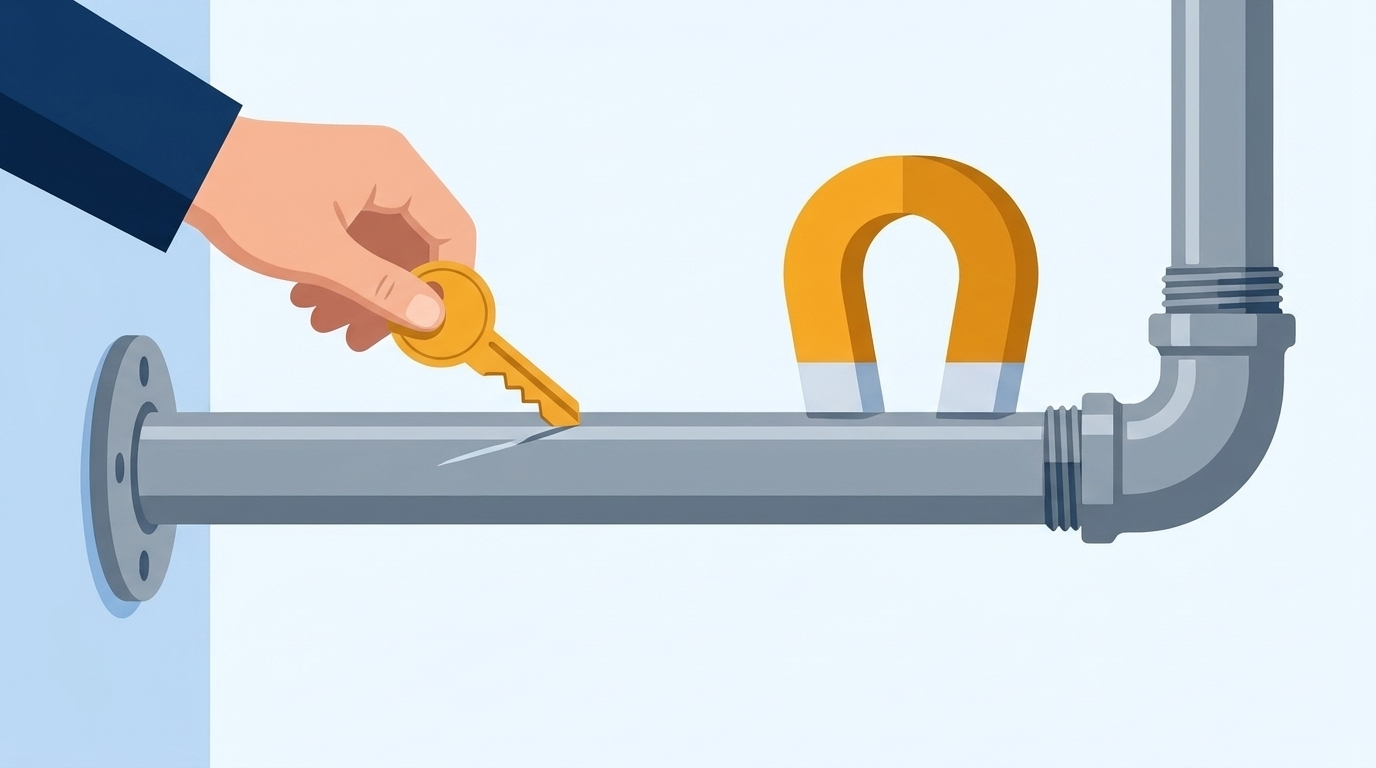
Material takes two small tests from EPA's Protect Your Tap guide, which was written for spotting lead service lines. They are done on metal pipe close to where it comes in through the wall or floor: a gentle scratch with a key or a coin, then a magnet. Orange or pale orange is copper. Gray pipe that is hard to scratch and holds a magnet may be galvanized steel. Gray pipe that is soft and does not hold a magnet may be lead, and the guide covers that result. HUD's guide describes copper as usually not subject to clogging by mineral deposits, which points a copper house back toward the regulator and the valves. Plastic pipe, polybutylene included, is covered in our guide to repipe costs in Port St. Lucie.
HUD's guide also treats rusted fittings and rust-colored water, particularly from hot water lines, as signs of advanced deterioration in galvanized steel. One sign comes in two stages: a clogged aerator gets cleaned, the flow comes back, and later the screen holds rust-colored grit again. One clog is a fixture problem. A screen that keeps refilling is being fed from upstream. In a 2026 r/askaplumber thread about galvanized pipe in an old house, one commenter told the owner the pipes were "failing and sending debris downstream."
What Makes Only the Hot Side Lose Water Pressure?
When cold is strong at every tap and hot is weak at every tap, the restriction is on the hot path, which starts at the water heater.
The simple suspect is the shut-off valve on the cold line into the water heater. All of that heater's hot water passes through it, so a valve left partly closed throttles the whole hot side.
The other two suspects come from HUD's 2000 guide. Where flow is lower at hot faucets than at cold, it says to suspect the water heater or, more likely, a buildup of rust and mineral deposits in the supply lines, which occurs faster in hot water. Rusty water only on the hot side, it adds, indicates rust in the water heater.
When Does Low Water Pressure Mean a Stuart Home Needs New Pipes?
When the simpler answers are ruled out and the evidence points at the pipe itself:
- The loss is whole-house and crept in over years.
- The hose bib gauge shows sound pressure coming in.
- The valves are fully open, and the regulator, if there is one, has been tested.
- The supply piping is galvanized steel and past its service life.
- The water shows rust, or grit keeps returning to the aerators.
HUD's guide reaches the same conclusion by elimination: where flow is low throughout a building, the supply is sound and no outside restriction is found, it says the piping is probably clogged by rust and mineral deposits and should be replaced. A sudden drop, a single weak fixture, a regulator that fails its test and a half-closed heater valve each point somewhere other than the pipes.
Replacing a home's supply lines is whole-house repiping, and it is work we do. Stuart is part of the Martin County area we cover from Port St. Lucie.
The Bottom Line
Low water pressure in a Stuart home is a sorting problem before it is a repair. One weak fixture is that fixture. A whole house that dropped within days points at an event: the utility, a valve, the regulator or a leak. A whole house that faded over years points at wear, and a gauge on the hose bib, with the pipe's material and age, shows whether that means the supply lines.